How to thrive through the crypto reset
A long talk argues the old financial world is burning down and a new one is being built on blockchain. This is the calm version. What in that story actually holds up, what is only a theory, what is just a price call, and the plain playbook Crypto XLNC follows, and you can follow, to come through the transition stronger rather than only intact.
Educational only. Not financial advice. Join Crypto XLNCStart your application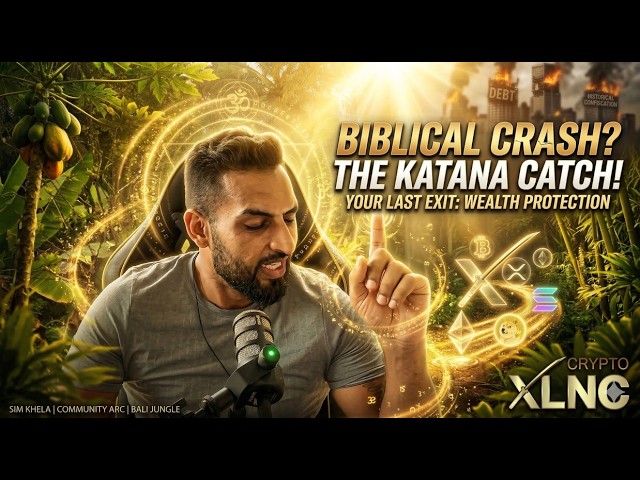
The full talk by Sim Khela. The page below sorts what holds up from what is contested or just a price call, and keeps the speculative parts clearly labelled. Open on YouTube
What is the crypto reset, and how do you thrive through it?
The crypto reset is the idea, argued at length in this talk, that the financial system is hitting a historic pivot, and that how you hold and manage assets through it will matter more than usual. Stripped of the prophecy, three parts of that idea hold up well. Counterparty risk is real, because FTX left about an 8 billion dollar hole in customer money after mixing deposits with its own trading arm. Source: CoinLedger The long tail of crypto mostly dies, because more than half, about 53 percent, of the roughly 20 million tokens launched since mid 2021 are already defunct. Source: CoinGecko And crashes are violent, because a single day in October 2025 erased about 19 billion dollars of leveraged bets.
The grander claims, a 250 year empire cycle, a coming great confiscation, exact price targets, are far more contested and should never be read as predictions. Crypto XLNC does not try to forecast the reset. It positions for it: own what you own, hold quality, manage volatility with rules, plan your exits, and build a reason to do all of it. This page is educational, and it is not financial advice.
The whole page in seven lines
- The crypto reset is a worldview, not a forecast. Crypto XLNC treats it as a reason to prepare, never as a date to trade.
- The grounded core is custody, concentration, and volatility. Counterparty risk, a dying long tail, and fast crashes are all measurable and real.
- The contested middle is the big cycle and the great taking. The mechanisms are real, the apocalyptic conclusions are disputed by experts.
- The speculative tier is the precise calls. A Bitcoin flush to the forties, an exact buy price, a 2028 date. No one can time a bottom, and none of it is advice.
- The playbook to thrive is five outer moves and one inner move. Own what you own, hold quality, manage volatility, plan exits, keep the long lens, and build a why.
- Active management is the strategy Crypto XLNC follows. Atreidis reads momentum and Katana Catch buys volatility, so rules act when emotion would freeze.
- The honest promise is clarity, not certainty. The talk hands you a map. You still walk the territory.
The forest fire, in plain words
The talk's central image is a forest fire. An old forest grows so dense and brittle that it must burn before anything new can grow, and the fire is not the end of the forest but part of how it renews. Applied to money, the claim is that the current system, built on government debt and a single reserve currency, is the brittle forest, and that a new base layer, blockchain, is the ground the next forest grows on. That is a worldview, and it is worth taking seriously without swallowing it whole.
Underneath the imagery sits one concrete claim that matters: the base layer is changing. The last cycle settled accounts in US dollars. The next one, the talk argues, settles them on shared ledgers that connect computers and, increasingly, software agents. A ledger is neutral. The same rails that can free people, through self custody and assets that cross borders, can also bind them, through frozen accounts and programmable money. The fork in the road, below, is the honest version of that idea. It is illustrative, not a forecast.
One base layer, two roads
The reset as a fork, not a prophecy
View the data
| Element | What it means |
|---|---|
| The base layer changes | Settlement shifts from US dollars toward shared blockchain ledgers and software agents. |
| The sovereign road | Self custody, tokenized hard assets, and value you can move across borders yourself. |
| The dependent road | Custodial holdings by default, where assets can be frozen, pooled, or made programmable by others. |
| Status | Illustrative. The diagram frames a choice of posture, not a forecast of the outcome. |
Sort the story into three buckets
A three hour talk mixes hard mechanics with grand theory and precise calls, and the honest thing is to keep them apart. Below, every major claim from the talk is tagged as grounded, contested, or speculative. Grounded means you can verify it from primary data. Contested means the mechanism is real but the conclusion is disputed. Speculative means it is a guess about the future or a precise call that no one can stand behind, including a few that are simply not advice. Use the filter to see one bucket at a time.
The claim triage
Tap a tier to filter
View the data
| Claim | Tier | Honest read and source |
|---|---|---|
| You do not fully own custodial assets | Grounded | FTX left about an 8 billion dollar customer shortfall (CoinLedger). |
| Most tokens are scams or dead | Grounded | About 53 percent of roughly 20 million tokens since 2021 are defunct (CoinGecko). |
| Crashes are violent and fast | Grounded | About 19 billion dollars of leverage wiped in one October 2025 day (CoinDesk). |
| Bond stress shows up before stocks | Grounded | The MOVE index often leads equity stress (Charles Schwab). |
| Tokenized gold is real and redeemable | Grounded | PAXG is one to one LBMA gold, redeemable (Paxos). |
| Shares are pooled entitlements, by law | Grounded | UCC Article 8 (1994) makes you an entitlement holder with a pro rata claim under 8-503; a secured creditor ranks ahead under 8-511 (The Great Taking; Cornell LII). |
| A coordinated great taking is coming | Contested | The legal mechanism is documented; the planned total seizure is Webb's contested thesis that critics call a misreading, and SIPC backstops US brokerage customers (The Great Taking; SIPC). |
| A 250 year and 84 year pivot | Contested | Dalio empire cycle and Strauss Howe saeculum, both real and both disputed (Bridgewater). |
| A derivative Ponzi about to blow | Contested | About 846 trillion notional, but about 22 trillion at risk, near 2.6 percent (BIS). |
| AI and robots end money | Contested | Plausible direction, speculative timeline (the talk's framing). |
| Bitcoin must flush to 40 to 50k | Speculative | A price call. No one can time a bottom. Not advice. |
| Buy XRP at exactly 0.6666 | Speculative | A vivid volatility idea, not a level to copy. Not advice. |
| Everything blows up by 2028 | Speculative | A precise date on an uncertain process. Not advice. |
| Move, harvest, ride a tax free 10x | Speculative | Indonesia's 0.21 percent taxes the trade, not the profit (KPMG). Not tax advice. |
The paper trail behind The Great Taking
The statutes and case law, not the prophecy
The strongest part of the talk is not the prediction, it is the record. In The Great Taking, the book and the documentary film by David Rogers Webb, free at thegreattaking.com, the legal change is laid out with the primary sources. Here is that trail, with each step linked to the law or the case itself. This is documented fact. What you conclude from it is yours.
UCC Article 8 is rewritten
The revision replaced direct ownership of shares with a security entitlement, a pro rata claim on a pooled fungible bulk. The principal drafter was Professor James Steven Rogers, and very few people understood the change at the time.Source: Cornell LII, UCC 8-503; The Great Taking
The Hague Convention and the EU collateral directive
The Hague Securities Convention introduced a new conflict of laws rule, PRIMA, to set jurisdiction at the intermediary, and EU Directive 2002/47/EC told members to switch off insolvency rules that would block a creditor realising financial collateral.Source: The Great Taking, chapter on Harmonization
The bankruptcy safe harbor
The Bankruptcy Abuse Prevention and Consumer Protection Act, effective October 17, 2005, exempted securities and derivatives contracts from clawback under section 546(e). Transfers of client collateral to secured creditors that were once challengeable as preferences can no longer be undone.Source: 11 U.S.C. 546(e); The Great Taking
The Lehman case sets the precedent
In the Lehman Brothers bankruptcy, Case No. 08-13555 in the Southern District of New York, the court upheld the safe harbor for JP Morgan as a financial institution and financial participant in the protected class, treating its taking of client collateral as exempt from challenge.Source: The Great Taking, citing the court decision
The EU locks in cross border mobility
EU Regulation No. 909/2014, the Central Securities Depositories Regulation, enabled the cross border movement of pooled customer collateral, mirroring the United States model where the DTC, through Cede and Co., holds shares in fungible bulk.Source: The Great Taking
View the data
| Year | Legal change | What it did, and the source |
|---|---|---|
| 1994 | UCC Article 8 revised | Replaced direct share ownership with a security entitlement, a pro rata claim on a fungible bulk (Cornell LII 8-503; The Great Taking). |
| 2002 | Hague Convention; EU 2002/47/EC | PRIMA conflict of laws rule, and EU members told to disapply insolvency rules blocking collateral realisation (The Great Taking). |
| 2005 | Bankruptcy safe harbor | The 2005 Bankruptcy Act exempted securities and derivatives contracts from clawback under section 546(e) (11 U.S.C. 546(e); The Great Taking). |
| 2008 to 2013 | Lehman case law | Case No. 08-13555, S.D.N.Y. upheld the safe harbor for JP Morgan as a protected financial participant (The Great Taking). |
| 2014 | EU CSDR 909/2014 | Enabled cross border mobility of pooled customer collateral, mirroring the US DTC model (The Great Taking). |
| Counterpoint | SIPC and scholars | SIPC backstops US brokerage customers to 500,000 dollars, and critics call the coordinated seizure conclusion a misreading (SIPC). |
The graveyard and the gravity
Why the talk says ignore the long tail and stay near the top
View the data
| Measure | Figure | Source |
|---|---|---|
| Tokens launched since mid 2021 | about 20 million | CoinGecko |
| Share now defunct | about 53 percent | CoinGecko |
| Bitcoin share of total value | about 56 percent | CoinMarketCap |
| Top ten coins share of value | close to 88 to 90 percent | CoinGecko, CoinMarketCap |
| Total crypto market value | about 2.2 trillion dollars | CoinMarketCap |
The headline number versus the real one
The derivative bubble, honestly measured
View the data
| Measure | Figure | What it captures |
|---|---|---|
| Notional outstanding | about 846 trillion dollars | contractual face value of all open contracts |
| Gross market value | about 21.8 trillion dollars | current replacement cost, the money at risk |
| Ratio | about 2.6 percent | gross market value as a share of notional |
The long clock
Drag the handle through the cycle the talk leans on
The United States and the dollar
The dollar has been the world reserve currency since the mid 20th century. Ray Dalio places the United States in the late stage of the empire cycle, powerful but in relative decline, with debt rising and a rival rising. This is where the talk says we stand.
View the data
| Era | Reserve power | Framework note |
|---|---|---|
| 1600s | Dutch guilder | Dalio big cycle, an empire rises on trade and finance |
| 1800s | British pound | the baton passes after conflict and debt |
| 1900s to now | US dollar | United States in late stage, relative decline, rising debt |
| The pivot | contested | Strauss Howe place a crisis turning roughly every 80 to 90 years; timing is not predictive |
Six moves to thrive, not just survive
Strip the prophecy away and a practical playbook remains, the same one Crypto XLNC follows. Five moves are the outer game, what you do with your assets. One is the inner game, what keeps you doing it when the screen is red. Each move links to a Crypto XLNC explainer that goes deep, so this page is the map and those are the chapters.
Own what you own
De risk what you cannot afford to lose. Keep long term holdings in self custody, understand that an exchange balance is a claim and not the keys, and use tokenized hard assets that can cross borders. After FTX, this stopped being philosophy.
Hold quality, skip the tail
Ignore the graveyard. With about 53 percent of tokens dead, a short list of large, liquid networks that already survived a brutal bear market is the lower risk starting point. The talk's rule of thumb is to keep most capital near the very top of the market.
Manage the volatility
Blindly holding through every drawdown drains sleep and judgement. The talk's alternative is active management: lean toward buying weakness and trimming strength, and let rules act when emotion would freeze. Volatility becomes the tool, not the enemy.
Plan the exit and the map
Decide in advance when to take your original stake off the table, and know the tax map before you move, not after. The talk's tax shortcuts are real ideas wrapped in risky specifics, so treat residency and harvesting as planning that needs a professional, never a copied trick.
Keep the long lens
Cycles rhyme. A ninety percent drawdown is a normal feature of crypto, not proof the world is ending, and the same was said in the dot com crash before the survivors compounded. Perspective is what stops a violent week from becoming a permanent decision.
Build a why, and your people
The talk is blunt that making money is easy and surviving the mind games is hard. A motivation bigger than a number, securing your family's freedom rather than just wanting a million, is what holds when markets test you. Build a small, trusted community that gets stronger under stress, and protect your energy from constant takers.
The strategy we follow, in one view
Crypto XLNC does not trade the reset prophecy. It runs a disciplined, rules based process on your own exchange account. The talk describes the same analytical stack the strategies lean on: watch where stress builds, watch where the dry powder sits, watch for exhaustion, then act on volatility instead of emotion. The signals below are legitimate tools, used as lenses, never as certainty.
The signal stack
From macro stress to a volatility entry
View the data
| Stage | Tool | What it reads |
|---|---|---|
| Macro stress | MOVE index | bond volatility that often leads equity and crypto stress (Charles Schwab) |
| Sideline cash | Stablecoin dominance | the share of the market parked in stablecoins, the potential buying power (TradingView) |
| Exhaustion | DeMark TD Sequential | a count that flags an overextended trend near a turn (TradingView) |
| The entry | Katana Catch | a rules based volatility entry rather than an emotional one |
About Crypto XLNC
Crypto XLNC is automated, non custodial crypto investing that runs directly on your own exchange account through limited, trading only API access. Your assets never leave your account, and Crypto XLNC cannot withdraw or move them.
It is spot only, with no leverage, and supports Kraken, Coinbase, and OKX, with Bybit where permitted. The minimum is 1,000 dollars, and the only charge is a 20 percent performance fee on new profits above your prior high, with a high water mark. Returns are not guaranteed and crypto trading carries risk.
Join Crypto XLNCStart your applicationWhich exchange, and why it matters
The talk warns against holding assets on venues with weak standing, and points to regulated, well backed exchanges instead. That caution is grounded. In 2023, Binance and its founder pleaded guilty to United States anti money laundering and sanctions violations and paid about 4.3 billion dollars, though the founder was later pardoned in 2025. Source: US Department of Justice.
Crypto XLNC works only with regulated exchanges you already trust, and never takes custody of your coins. Where they sit and who can touch them is the first risk to control.
Signal on one side, story on the other
The talk is a coherent worldview that blends real financial mechanics with contested theory and precise calls no one can stand behind. Weigh it honestly and the scale does not tip to prophecy. It tips to posture. The grounded parts, custody, concentration, volatility, and discipline, are worth acting on now. The speculative parts are worth hearing and holding loosely.
View the data
| Side | What sits there | How to use it |
|---|---|---|
| Signal | counterparty risk, concentration, fast crashes, real market lenses, the value of rules | act on it now, calmly |
| Story | the great taking, the 250 and 84 year timing, the end of money, exact price calls | hear it, hold it loosely, never trade it as fact |
| Net read | posture beats prophecy | clarity, not certainty |
Position for the transition, calmly
Automated, non custodial crypto investing that runs directly on your own exchange, supported by real people. Spot only, with a performance based fee. The same discipline this page describes, run for you.
Join Crypto XLNCStart your application An invitation to the platform, not financial advice. Your assets stay in your own exchange account.Honest answers to the hard questions
Is the great reset really happening?
Isn't active management worse than just holding for most people?
What about the specific price calls, like Bitcoin to the forties or XRP at 0.6666?
Is The Great Taking a real legal risk?
Does the tax move really let you ride a 10x tax free?
What does Crypto XLNC actually do during a crash?
How this was made, and by whom
This explainer takes a long form Crypto XLNC talk and tests its claims against primary and authoritative sources, keeping what holds up, marking what is contested, and labelling what is only a forecast or a precise call. Figures are rounded and dated, and every load bearing number carries its source next to it. The goal is the most honest reading of the worldview that exists, not a louder version of it.
More than 14 years of crypto market experience, including five years running a crypto fund. Indonesian Ambassador for the Global Blockchain Business Council and Co Founder of Farmsent. A regular voice across Real Vision, RVIP, Elevation Barn, and GRIM.
Last updated
What changed on June 13, 2026: added the documented legal record behind The Great Taking, the 1994 UCC Article 8 revision, the 2005 bankruptcy safe harbor, the Lehman ruling, the Hague Convention and EU CSDR, sourced to David Webb's book and film and to the primary law, and split the grounded legal mechanism from the contested prediction of a coordinated seizure.
The entities on this page
- Crypto XLNC
- Crypto XLNC is the automated, non custodial crypto investing service that trades in your own exchange account through limited trading only API access.
- Sim Khela
- Sim Khela is the author, a crypto markets specialist with more than 14 years of experience, Indonesian Ambassador for the GBBC, and Co Founder of Farmsent.
- Farmsent
- Farmsent is the food security platform that Sim Khela co founded.
- GBBC
- The Global Blockchain Business Council is the industry association where Sim Khela serves as Indonesian Ambassador.
- Atreidis
- Atreidis is a Crypto XLNC strategy that responds to price and volume momentum, with volume based exits.
- Katana Catch
- Katana Catch is a Crypto XLNC strategy built on volatility driven entries.
- The Great Taking
- The Great Taking is a 2023 book and documentary film by David Rogers Webb, free at thegreattaking.com, documenting how security entitlements and the 2005 bankruptcy safe harbor leave investors exposed in a financial collapse. The legal record it cites is real; its prediction of a coordinated seizure is contested.
Plain words glossary
- Security entitlement
- The legal form of most modern stock and bond ownership. Under UCC Article 8, section 8-503, you hold a pro rata claim on a pooled fungible bulk through an intermediary, rather than direct title to a specific asset.
- Fungible bulk
- A single undivided pool of identical securities held by a depository such as the DTC. Investors own a pro rata slice of the pool, not specific shares, which is what makes pooled collateral possible.
- Safe harbor, 2005
- Provisions added to the US Bankruptcy Code in 2005 that exempt securities and derivatives contracts from clawback under section 546(e), so collateral transfers to secured creditors cannot be undone in a bankruptcy.
- Counterparty risk
- The risk that the other side of an arrangement, such as an exchange holding your coins, fails or misuses your assets. Self custody removes it for the assets you hold yourself.
- Notional versus gross market value
- Notional is the headline face value of a derivatives contract. Gross market value is the money actually at risk, which is usually a tiny fraction of notional.
- MOVE index
- A measure of expected volatility in US government bond yields, often called the VIX for bonds. A spike can signal stress before it reaches stocks and crypto.
- Stablecoin dominance
- The share of total crypto value held in stablecoins. High and rising means caution and sideline cash, falling means capital rotating back into risk assets.
- Saeculum
- In Strauss and Howe's theory, a full social cycle of about 80 to 90 years, ending in a crisis turning. A popular framework, and an academically contested one.
- Antifragile
- Nassim Taleb's term for systems that gain from disorder rather than merely surviving it. The talk applies it to communities that get stronger under stress.
Sources
- Bank for International Settlements, OTC derivatives statistics at end June 2025 (bis.org).
- CoinGecko Research, dead coins and how many cryptocurrencies have failed (coingecko.com).
- CoinMarketCap, Bitcoin dominance and total market value (coinmarketcap.com).
- Charles Schwab, what the MOVE index is and why it matters (schwab.com).
- Paxos, Pax Gold, the gold backed token (paxos.com).
- US Department of Justice, Binance and CEO plead guilty (justice.gov).
- KPMG, Indonesia updated tax rates for cryptoasset transactions (kpmg.com).
- David Rogers Webb, The Great Taking, the book and documentary film, free online (thegreattaking.com).
- Cornell Legal Information Institute, UCC Article 8, sections 8-503 and 8-511 (law.cornell.edu).
- US Bankruptcy Code, the safe harbor at 11 U.S.C. 546(e) (law.cornell.edu).
- SIPC, what the Securities Investor Protection Corporation protects (sipc.org).
- Ray Dalio, The Changing World Order (bridgewater.com).
- CoinLedger, the FTX collapse explained (coinledger.io).
- Source talk, Sim Khela for Crypto XLNC (youtu.be/0e6iQzvx2Fk).