XLNC Academy · An Interactive Exhibit
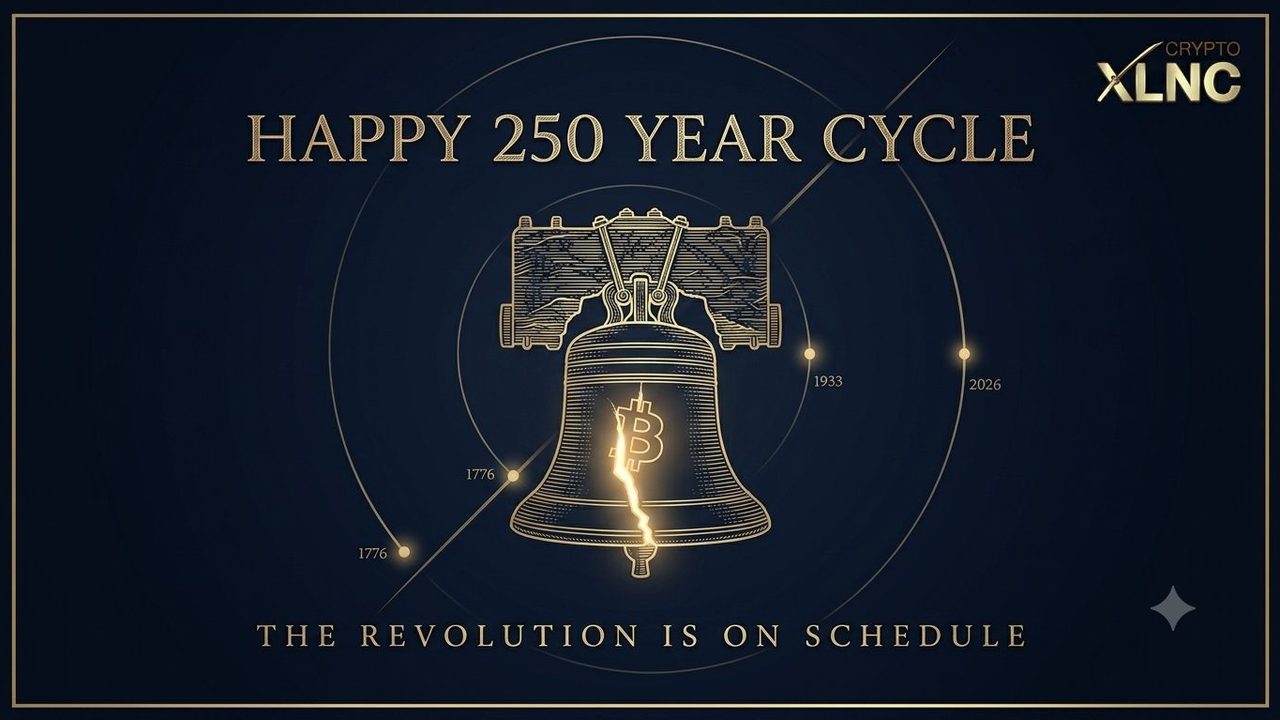
Happy 250 Year Cycle
Today is July 4th, 2026. Exactly 250 years since the Declaration of Independence. This is not a birthday. It is a reset. This exhibit shows you the machinery behind it, one chapter at a time.
The full talk by Sim Khela. The nine chapters below are the same argument, rebuilt as an interactive exhibit you can walk at your own pace. Crypto XLNC on YouTube

Tap the bell
Plate I The bell that rang in the last cycle. The crack is new money.
“First the mind frees itself. Then the money. Then the nation.”
Chapter II
The Clockwork of History
Three cycles converging at once. History does not repeat on a whim. It runs on generational memory, and memory runs out on a schedule.

Plate II The orrery of revolutions. Drag the years; watch the hands meet in 2026.
Cycles are not magic numbers. They are generational memory. A debt supercycle takes three to four generations to build, because that is how long it takes a society to completely forget what the last collapse felt like. When the last person who remembers the last reset dies, the next reset begins. The dates are decoration. The mechanism is human forgetting.
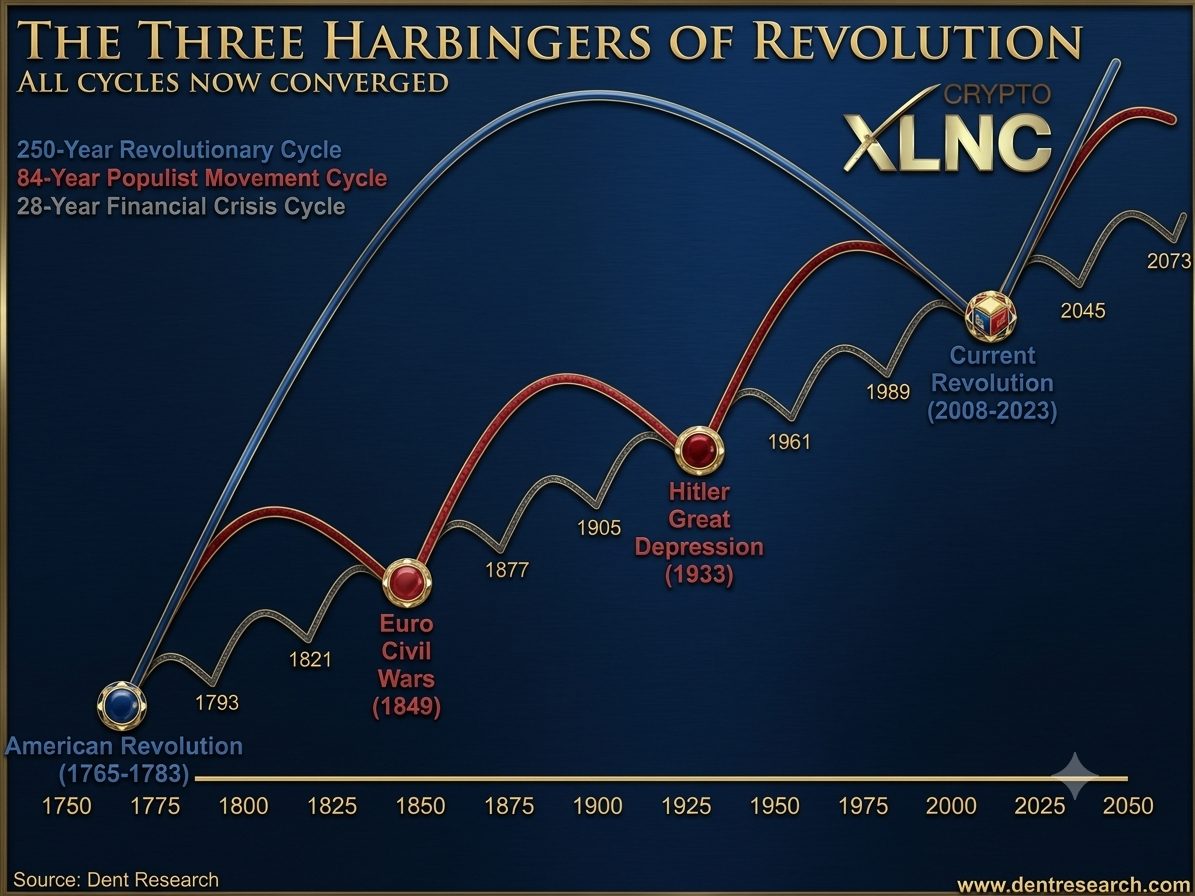
Stack three forgettings on top of each other and you get the chart below: the 250-year revolutionary cycle that resets political orders (1776 to 2026), the 84-year populist cycle that resets social contracts (1849, 1933, 2017), and the 28-year financial crisis cycle that resets markets (1989, 2017, now). Three separate clocks, wound at different speeds, all striking together once in a civilisation's lifetime. The last full conjunction gave us 1776. The next one is now.
And if you prefer the energy view to the historian's view: nothing in nature moves in straight lines. Breath, tides, seasons, empires. Everything spirals. We are at the exhale.
An honest footnote on the dates
The specific years are pattern-recognition over a small sample of history, and any honest reading says so: you cannot statistically prove a 250-year law from two or three observations. What is real, measurable, and does the actual work is the mechanism: debt accumulating faster than income for generations, monetary control tightening as the debt grows, and living memory of the last reset dying out. Treat the dates as a rhyme scheme, not a train timetable. The rhyme is loud enough.
Plate III The source document, cycles after Dent Research. Click to study it.
Chapter III
What Actually Caused 1776
It is not what school told you. It was a sovereign debt crisis that became a legitimacy collapse.
Britain came out of the Seven Years' War in 1763 with its debt doubled to £130 million, and interest ate half the budget. Sound familiar?
The empire's answer was to extract from the productive periphery: the Stamp Act of 1765, the Townshend duties, the Tea Act of 1773. But the real wound was monetary. The Currency Acts of 1751 and 1764 outlawed colonial paper money. The colonies lost monetary sovereignty overnight: forced deflation, no money to trade with, an economy strangled by decree from London. Benjamin Franklin said the currency ban angered the colonies more than any tax.
Taxation without representation was the slogan. Money without sovereignty was the cause.
Five ingredients made the revolution. Memorize them, because you are going to see every one of them again. Flip each card from 1776 to 2026.
Five for five. Same recipe.
Chapter IV
The Mirror
Two centuries, one composition. Drag the blade and make 1776 and 2026 trade places. Touch the paired emblems to see why each one rhymes.

SAME EMPIRE. SAME PLAYBOOK. NEW MONEY.
Plate IV The mirror. Drag the katana line; light one century, dim the other.
Two clocks are striking at once. 250 years after 1776. 80 years after 1945.
Bretton Woods made the dollar the world's reserve order in 1945, born from the ashes of the war. In 1971 Nixon closed the gold window: the halfway point, where the order went pure fiat. Add 80 years to 1945 and you land here, where the order is dying on schedule.
And the empire is smarter this time. Legalizing dollar stablecoins is the Crown letting the colonies print, but only in sterling: it extends the dollar's life by putting it on the revolution's own rails. Study the mirror long enough and you stop asking whether the pattern is repeating. You start asking where in the pattern you are standing.
Chapter V
Revolutions End When the Money Is Born
The timeline shape is how you project forward. Touch each node; the second arc is running sixteen years behind the first.

Plate V Two arcs, one clock. The pulsing flame is you.
The dollar was born 16 years after the Declaration.
Revolutions do not end at victory. They end when the new money is ratified.
Look at the top arc. An agitation decade from 1765 to 1775, the rupture of 1776, victory in 1783. And then the phase everyone forgets: 1783 to 1787, the Articles of Confederation. The old order dead, the new order not born. Fragmentation, competing currencies, near-collapse. Only then came the reconstruction: the Constitution in 1787, Hamilton assuming the debts in 1790, the First Bank in 1791, and the Coinage Act of 1792. The dollar.
Now look at the bottom arc. If 2008 was the Stamp Act and 2009 the Declaration, we are standing in the interregnum, and everything around you makes sense: old order dead, new order not ratified. This is why everything feels broken. It is supposed to.
Chapter VI
The Quiet Revolution Already Happened
Not a forecast. Receipts. The world's central banks have been voting for years, and they vote in tonnes.

Plate VI The scale tipped in June 2026. It had not tipped since 1996.
US national debt, growing while you read this. US Treasury, Debt to the Penny
The pace the debt grows. Interest now eats roughly 14% of federal spending.
Central bank gold buying per year, three years running. World Gold Council
The dollar's share of global reserves, 1999 to now. IMF COFER
In June 2026 the European Central Bank confirmed it: gold has surpassed US Treasuries as the world's largest reserve asset, for the first time since 1996. 74% of central banks expect the dollar's share to keep falling.
Gold hit $5,589 in January, an all-time high, before the empire's paper markets clawed it back. The direction survived the raid. The nations of the world are doing exactly what colonial merchants did in the 1770s: quietly refusing the empire's paper.
That is the quiet revolution. No declaration, no musket fire. Just reserve managers, meeting after meeting, moving the world's savings out of promises and into weight.
Chapter VII
As Above, So Below
This bear market is a fractal: the same crash pattern repeating at every timeframe. Zoom in and watch the shape sign its own name.

Plate VII Fractals are how nature signs her work, and how forced liquidation signs its.
Weekly, daily, hourly: distribution, breakdown, dead-cat bounce, lower low. The same signature at every scale, which is what forced liquidation looks like when it cascades through leverage. On the daily, the February crash landed with the war, the recovery trend broke on June 1, and price fell below the 20, 50, and 200-day moving averages together.
Capitulation psychology is a contrarian signal. But oversold is not the same as bottomed. Hold both of those in your head at once; that is the whole discipline of this phase.
Chapter VIII
Paper to Physical
Three wedges, one geometry, opposite directions. That is not coincidence. That is capital rotating.

Plate VIII Energy leaving paper risk, flowing into physical reality.
XRP built a multi-month wedge, lost the $1.25 support, and broke down to $1.13. Textbook. Solana, the $280 star of 2025, rolled into the same descending structure and broke the same way. Then overlay oil: Brent's wedge broke upward when Hormuz closed, toward $120. Same geometry, opposite directions. Energy is leaving paper risk and flowing into physical reality.
You need to understand what just happened. On February 28, 2026, the US-Iran war turned the Strait of Hormuz into a militarized chokepoint. About 20% of the world's oil supply was disrupted; Brent spiked roughly 64%. This is the first crypto cycle ever to face a hot war with a major oil producer.
Trace the chain reaction most people have not traced. Oil up, so inflation up, so the Fed's rate cuts are dead, with some officials talking hikes. Rate-cut hope was the entire bull thesis for risk assets. The ETFs flipped to sellers: $3.8 billion out of Bitcoin funds in the worst month, while gold ETFs absorbed $16 billion in the same window. The rotation from digital gold to physical gold is the trade of 2026.
And the empire's debt math just got worse: war spending on top of $2 trillion deficits, higher rates compounding on $39 trillion. The doom loop accelerates. The 1776 rhyme is exact: the Seven Years' War broke Britain's balance sheet and triggered the extraction that caused the revolution. This war is doing the same thing to this empire, in real time, on your screen.
The oil shock has not fully hit yet. It moves in four waves.
The 1970s already rehearsed this: the 1973 oil shock brought stagflation, and gold rose roughly 24x in a decade. If the rhyme holds, the final washout in crypto likely comes on Wave 3. Historical cycle timing clusters around Q4 2026, roughly twelve months from the October top. That washout is not the end. It is the entry.
One more thing history insists on: the empire counterattacks. Capital controls, CBDC pushes, crackdowns. 1812 followed 1783. Expect it. Do not fear it.
Chapter IX
The Reconstruction
Where this goes, and who it rewards.
First the mind frees itself. Then the money. Then the nation.
The dollar was born 16 years after 1776. The successor system is being born 16 to 20 years after 2009. Do the math.
The Hamiltonian moment, the new monetary constitution, projects to roughly 2028–2033: tokenized sovereign debt, neutral reserve assets in gold and increasingly Bitcoin, blockchain rails replacing correspondent banking, multipolar settlement with no single crown. Then a long expansion into the 2040s. The next crisis node on the clock: 2045.
You are not late. You are early to the reconstruction.
And what do we do, concretely? You cannot time a revolution with emotion, which is why at Crypto XLNC the system trades, not us. The Katana catch was built exactly for the falling-blade phase, catching capitulation with structure instead of feelings. The Atreidis exit follows on-balance volume, the energy, not the noise of price. Pairing against USDC keeps dry powder as a position: in 1786 the man holding hard money bought the future at a discount. And the physical layer is why we talk about gold, land, food, and energy. Paper versus physical is not a slogan. It is the allocation.
Hold the frame. Bear markets are the empire's counterattack. Reconstructions reward the prepared, not the fastest.
Prove you walked the exhibit
1. What actually caused the American Revolution of 1776?
A sovereign debt crisis that became a legitimacy collapse. Britain's debt doubled to £130 million, interest ate half the budget, and the Currency Acts stripped the colonies of their own money. Taxation without representation was the slogan; money without sovereignty was the cause.
2. How many of the five ingredients of a monetary revolution are present in 2026?
Five for five. Indebted empire, monetary control, crony bailout, new information technology, and the consciousness shift that always comes first.
3. How long after the Declaration was the dollar born, and why does it matter?
16 years, with the Coinage Act of 1792. Revolutions end when the new money is ratified, not when independence is declared. Mapped from 2009, that points to roughly 2028–2033.
4. What phase of the cycle are we in right now?
The interregnum, our Articles of Confederation phase: the old order has conceded authority and the new one is not yet ratified. It is supposed to feel broken.
5. What are the four waves of the oil shock, in order?
Markets, Prices, Debt, Debasement. Wave 1 is done, Wave 2 is arriving, Wave 3 likely brings the final washout around Q4 2026, and Wave 4 is the exit that hard assets are pricing.
Happy 250th
The revolution is on schedule.
If this exhibit changed how you see 2026, walk the rest of the Academy, or apply to have the system trade the cycle for you while you live your life.
Education, not financial advice. No method can time a market top or bottom.